

When drafting helps, and when it can hurt.
· Wind
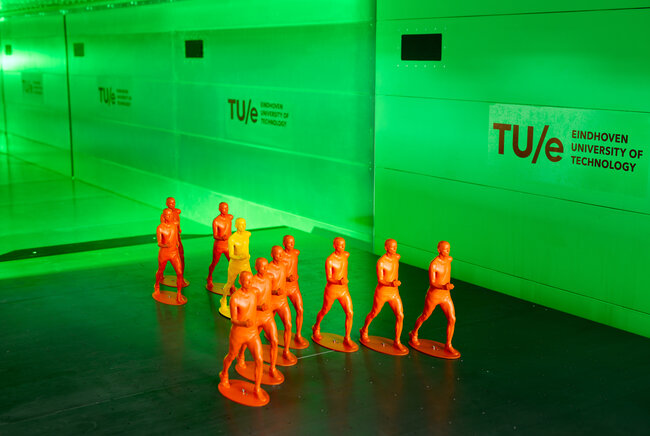
Drafting is a significant but often overlooked race strategy which can save you critical time on race day. Essentially, drafting is when you run closely behind the runner, or group of runners in front, so that you are shielded from some of the airflow coming towards you. Whilst this might seem to be only of importance in particularly windy weather or when racing into a headwind, it can also help on still race days, as you are still moving through the air as you run.
Why it works
Simply put, the greater your speed relative to the air around you, the greater the aerodynamic drag acting on your body. This relative speed is determined by your pace, as well as the oncoming wind speed. The faster you run, or the greater the headwind, the greater the air resistance you experience. Air resistance increases with the square of this relative speed, so a small increase in speed can lead to a surprisingly large increase in drag.
Drafting works by reducing the amount of air resistance that you have to overcome. By running in the sheltered area behind another runner you can reduce aerodynamic drag and therefore use less energy to maintain the same pace.
Pugh's 1971 work on the impact of wind resistance in running is still held as the go-to reference for drafting. He found that, at middle-distance running speeds on the track, overcoming air resistance accounts for around 7-8% of a runner's total energy cost, a very significant value. At marathon pace the impact may be smaller but it is still real. Marathon runners are also more likely to experience significant headwinds which could raise this value further. Pugh's study concluded that running about a metre behind someone on the track dramatically reduced air resistance and reduced the oxygen cost of running by around 6.5%.
No longer the preserve of cyclists, drafting is increasingly used by professional and amateur runners alike as a key component of their race strategy. Recent wind tunnel and computational fluid dynamic studies have shown that, done correctly, drafting can reduce aerodynamic drag by 80-90%, saving elite marathon runners minutes over the marathon distance. Elite races increasingly showcase athletes using this research and holding back to use rivals as windbreaks, instead of pushing the pace early on.
Perhaps the most visible example of this was the INEOS 1:59 challenge, where Kipchoge ran a sub-two-hour marathon with the help of a carefully organised and planned group of pacemakers who took turns to run in arrow formation in front of Kipchoge. By running in their slipstream it has been estimated that Kipchoge shaved more than 3 minutes off his time.
Real world example: Edinburgh 2025
Edinburgh Marathon 2025 was a great example of a race where drafting had a significant impact. Wind played a significant part that day, with strong westerlies and gusts of up to 40mph. The course is notoriously susceptible to wind, being run mostly directly along the seafront, and is an out-and-back route. This worked to the runners' advantage on the way out heading east and allowed many to bank some time, but on the return leg the headwind had a huge impact on individual runners. The difference between running into that wind alone and running in a group was substantial.
This is when drafting comes into its own as a race strategy. You can't eliminate the wind, but you can take steps to avoid the full force of it yourself. Finding a group travelling at your pace can therefore be one of the simplest ways to reduce the cost of particularly windy sections of the course.
When to draft
Drafting is most valuable when:
- You're moving reasonably fast (air cost rises quickly with speed)
- There's a significant headwind (approximately 10 kph / 6+ mph or more)
- The road is long and straight enough to stay organised and in formation
- There's an experienced group already running at your desired pace
Drafting can still be a useful tool on calmer days too, it will just result in a smaller payoff. Importantly, make sure that you have practiced drafting before the race and are comfortable with running so close to the person in front, as it can feel strange initially.
Also make sure that you know your pace plan for the race so that you can choose the correct group or individual to sit behind. A group running 20 seconds per kilometre too fast will never be a good pacing strategy, no matter how much they shelter you.
When to avoid drafting
When running into a tailwind, the benefits of drafting can be outweighed by a loss of cooling due to reduced airflow. This is particularly notable in hot conditions where heat has a much greater impact than air resistance. If it is a dry heat it would be sensible to sit a little further back from the runner in front. If the weather is very hot and humid then you might be better off not to draft at all. Instead run more independently and allow air to flow freely around your body to help with cooling.
This is an important trade off to note. The strategy that might save you energy from less wind resistance is not necessarily the strategy that will keep you coolest. In hot conditions, managing heat might be much more important than reducing aerodynamic drag.
It is also critical to carefully assess the pace of the runner in front. If their pace matches yours then drafting is a sensible choice. However do not follow them blindly. Keep an eye on things and be ready to back off or push on to stick to your own pace plan if their pace is not right for you.
How MeteoPace can help
MeteoPace factors in wind speed to help you plan for your next race. It can help you understand where wind is going to be a meaningful factor, rather than simply telling you that it will be windy.
It can also show you what impact wind had on your completed runs, giving you a way to compare your performance across different conditions and build a better understanding of how much wind affects your pace. You can even toggle drafting on or off to really understand the impact that it will have on your race or workout.
Used at the right time, drafting can be a simple way to reduce the impact of the wind and help you stick to your race plan.
Check the course and conditions for your race. For city courses, read why the wind can feel different from the forecast.