

What hills actually cost.
· Elevation
How gradient changes the cost of running
When it comes to running, not all kilometres are made equal.
A flat kilometre and a kilometre that climbs a steep hill may cover exactly the same distance, but the energy cost of running them can vary dramatically. The same is true for downhill running. Whilst a gentle downhill gradient can actually be cheaper than running on the flat, the cost starts to rise again as the downhill gets steeper.
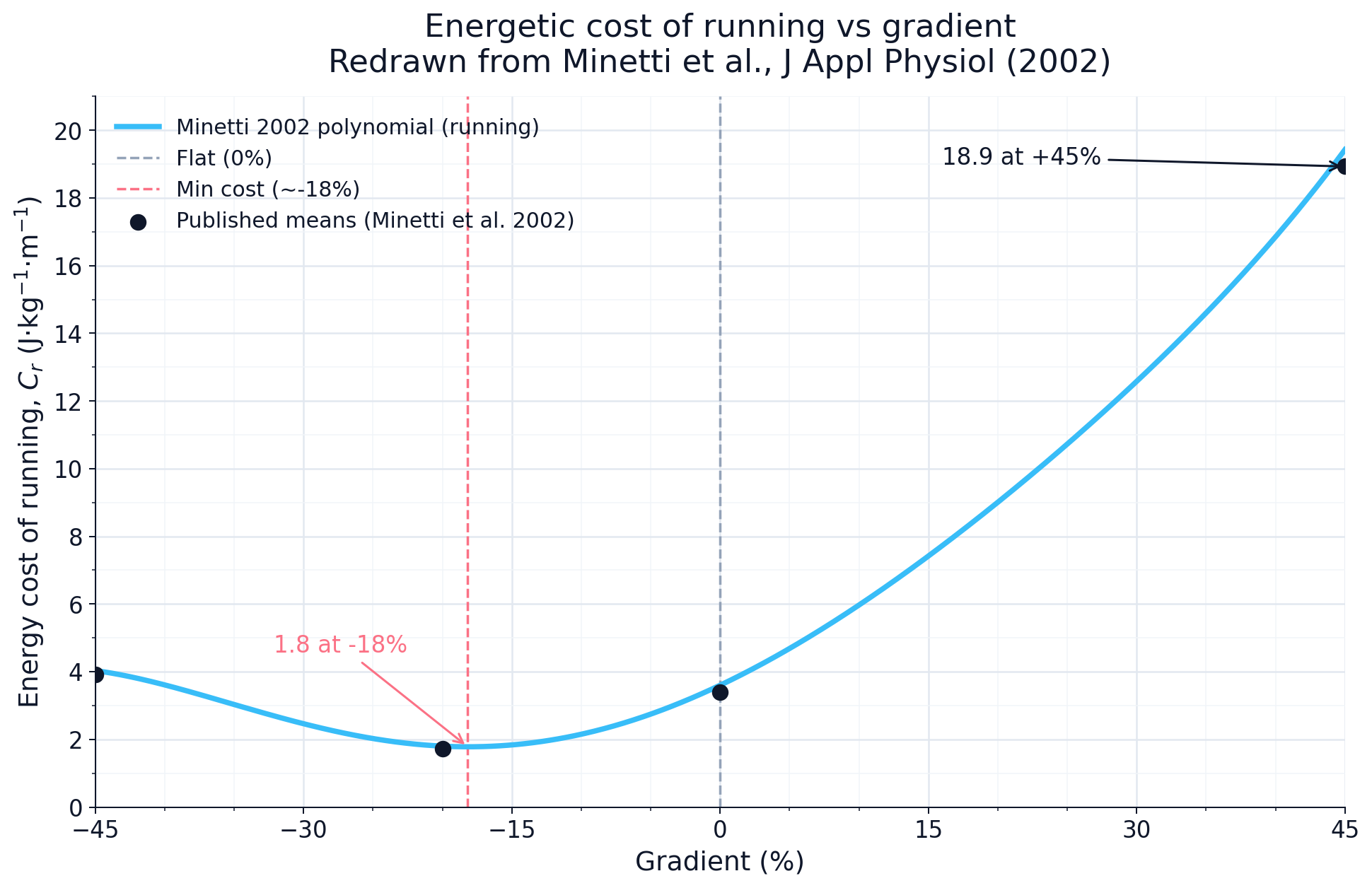
One of the clearest demonstrations of this comes from a 2002 study by Alberto Minetti et al. They measured the metabolic energy cost of walking and running on a treadmill at varying gradients, from −45% to +45%. The energy cost of running per metre follows a U-shaped graph, with the lowest energy costs to be found on moderate downhill gradients, and the energy cost rising rapidly as you climb upwards, or as you start to descend steeply.
The key takeaway is that hills do not just add elevation. They fundamentally change the cost of every single metre that you run. Understanding these costs is key to running the best race possible for the course in front of you.
Uphill running
When running uphill, the cost starts to rise surprisingly early, even on seemingly gentle slopes. Once the gradient reaches +10%, or a moderately steep hill, the energy cost is approximately 65% higher than on the flat. By +30%, the energy cost is around 3.5 times higher than on the flat. Once you approach gradients of +45% (the highest tested by Minetti) the energy cost is equivalent to around 5 times that of flat running, and walking becomes a real alternative.
Clearly gritting your teeth and trying to run steeply uphill at the same pace as on the flat is not going to work. The pace may look familiar on your watch, but the effort that is required to maintain it does not. Runners need to be able to adapt their pace to match the differing requirements of different gradients.
Correct uphill technique also becomes important with increasing gradient: shortening the stride, leaning into the hill slightly and making greater use of your arms. On very steep climbs, walking may be the most economical option. You can also support uphill running behind the scenes with strength work and regular hill training.
Downhill running
Downhill running is more complicated. It may feel 'easy', and to a certain extent this is true. In the 2002 Minetti measurements, running cost was found to be lowest at around −18% (about 1.8 J·kg⁻¹·m⁻¹), approximately half of the energy cost for running at a 0% gradient.
However, this does not mean that steeper is always better. Once the gradient reaches −45%, the energy cost is actually slightly higher than running on flat ground.
There will also be other mechanical consequences to bear in mind. Your quads will pay for it, particularly on steep descents, and there could be a greater risk of injury due to overstriding.
A course with 500 metres of climbing and 500 metres of descending is therefore not equivalent to a flat course, even if the total elevation gained and lost balances out. Some of the energy cost of climbing will be offset by the relative efficiency of running any gentle downhills, however any steep descents bring their own mechanical demands. The eccentric loading on your quads can cause significant muscular fatigue and damage, which may affect your running later in the race.
You can mitigate against this by training specifically for downhills. However, approach this with caution. Moderate downhill training is beneficial, but fast running down very steep gradients without prior training will leave you sore for days and could put you at serious risk of injury.
What to do with a course profile
Once you have a specific race or route in mind, you can use the course profile and Minetti's results to inform your pacing strategy.
As a rough guide:
- On the flat: normal race pace
- Gentle downhill (up to −10%): let the pace come down naturally. Running is cheaper here, but don't push too hard
- Gentle uphill (up to +10%): expect pace to slow slightly. Focus on maintaining a consistent effort
- Steep uphill (10%+): the effect will be more pronounced. Effort should take full priority over pace; focus on technique
- Moderate downhill (−10% to −20%): close to the point where the energy cost is at its lowest. Make up some time, stay relaxed and controlled
- Steep downhill (20%+): advantage starts to disappear. Braking forces increase, and the muscular cost of controlling descent becomes greater. Faster is not necessarily better
You should aim for your pace to respond to the terrain rather than fight it. That's where MeteoPace comes in. We combine the course profile with conditions to build a personal pacing strategy for the race that you are actually going to run, to help you decide where you can afford to push, when it might be wiser to hold back, and which parts of the course might naturally play to your advantage. The key to a fast time is not always a fast pace.
Find your race and its course profile to put this into context. Then check what heat and humidity mean for running pace.