

Hit Your Autumn Marathon Goals with MeteoPace and CORE
· Heat
Autumn marathon conditions can be unpredictable. A warmer-than-expected morning, direct sun, humidity, or even wind can change what it costs to hold your target pace. Over 42.2 km / 26.2 mi, even a small increase adds up to minutes.
MeteoPace uses your numbers with the course and the weather to show how those conditions are likely to hit your performance. Instead of “it might be warm,” you get what that warmth could mean for your pace.
The next few months cover a lot of marathon dates. Berlin in late September is not Valencia in early December. If you race in the southern hemisphere, this block is spring, not autumn. Most people still plan as if they’re getting the cool version. Sometimes they are. For some races the number is close to zero. Either way, weather over the next few months can be unpredictable, and with all the recent heatwaves across the globe, there is a non-zero chance heat will have an impact on your marathon time.

What the warm end costs
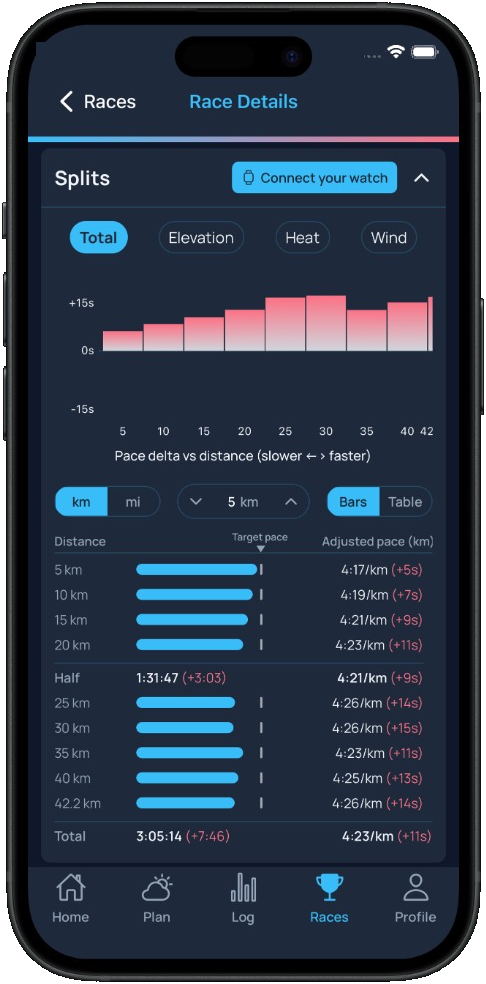
Berlin, 21 September 2025. 09:15 start. About 20°C / 68°F at the gun, about 25°C / 77°F at the finish. The course is almost free. Flat, barely any elevation. Heat is the one that moves.
For a 3-hour runner (70 kg, 178 cm) with no heat adaptation, heat impact added +7:17. Halfway you’re already +3:03 down.
That’s last year’s race morning. This year Berlin is a week later, 27 September. You probably won’t get last year’s heat. You also probably won’t get ideal.
Over the last 10 years, late-September and early-October mornings around a 09:15 start are a mixed bag. Only 15% of those hours are at 10°C / 50°F or below. The pile is around 15°C / 59°F. The morning still warms as you run.
On a typical morning in that pile, heat costs the same 3-hour runner +2:44. Not a heatwave. Still enough to take minutes off the time your fitness earned, unless you do something about it.
A few degrees is a meaningful difference over 42.2 km. Moderate heat doesn’t just add a few seconds a kilometre. It raises the chance of a big positive split, and that chance climbs fast. The heat is already eating your first-half pace and the day is still warming up. The right thing to do is back off. Holding even pace slower than your A-goal is hard for a lot of egos. Hold the original goal anyway and a small fade becomes a blow-up.
If you’re chasing a specific finish time, that difference matters. The earlier you see the heat, the more time you have to prepare.
Berlin air temperature, this year's race week
Last 10 years · 22 Sep–2 Oct · 09:15 start
How to avoid heat costs
You cannot control the weather. You can prepare your body for it.
Heat training, or heat acclimation, is controlled exposure over days or weeks so the body adapts. Those adaptations help you handle thermal strain and cut the heat cost on race day. Long-term heat training can even lift performance markers in cool conditions.
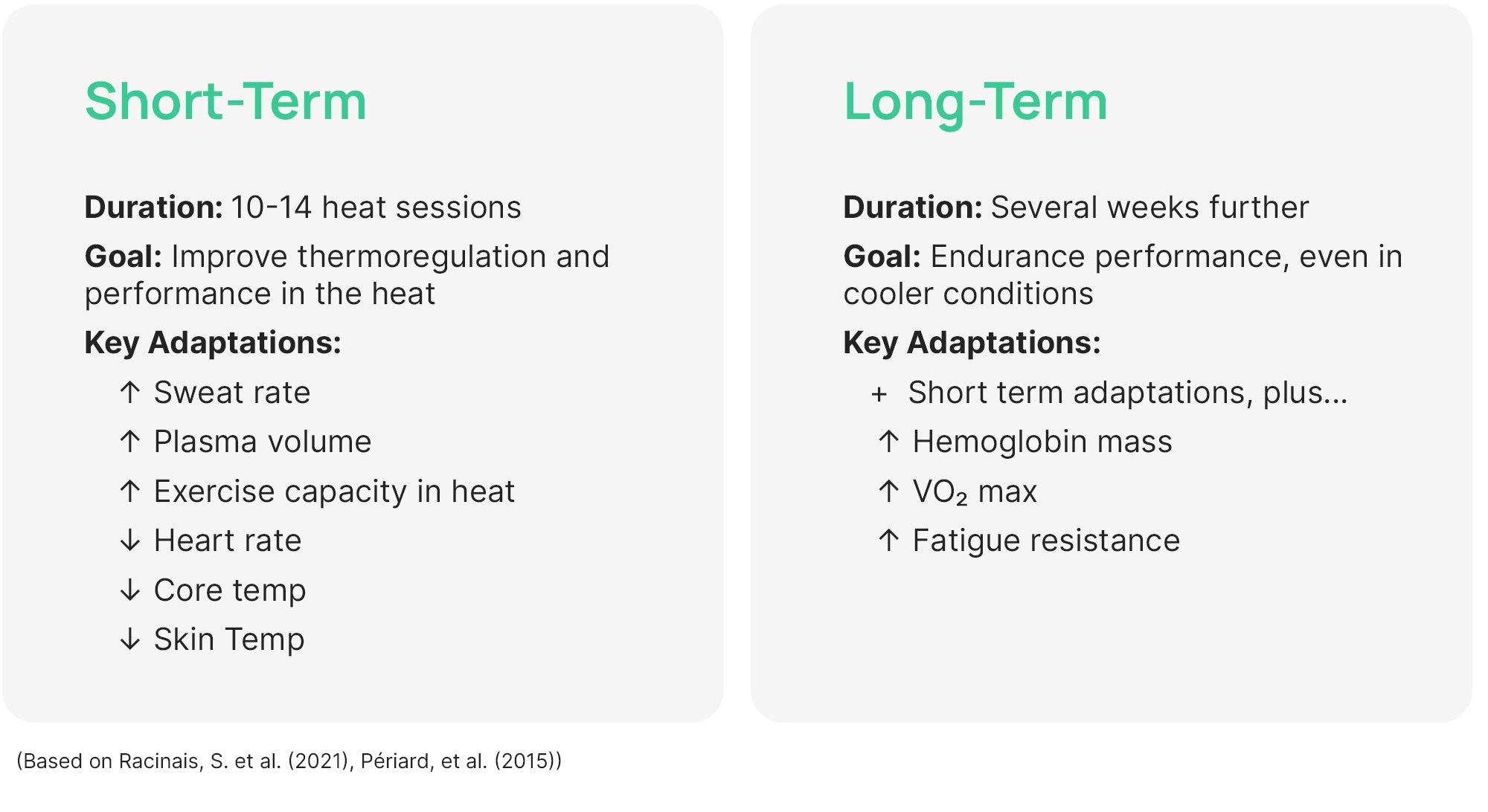
On that typical late-September morning, the same 3-hour runner goes from +2:44 with no adaptation to +0:43 after a standard protocol, and +0:13 after an extended one.
Typical late-September morning, heat only
3-hour runner · 70 kg · 178 cm · last ten years · 22 Sep–2 Oct
Impacts using the MeteoPace heat model.
Last year’s warm morning was much more. On a cooler one, the same work takes the bill to zero.
Last year’s warm morning was much more. On a cooler one, the same work takes the bill to zero.
That’s the insurance. If race day is warm, you lose minutes instead of falling apart. If it’s cooler, heat might not cost you anything.
In MeteoPace, heat adaptation changes what heat costs you on race day and in training. Raise the adaptation and the heat impact comes down. You can build it with passive heat (sauna or hot bath) or with active heat training on runs you already have.
Control over your heat training
Passive sessions are easy to put next to hard running days. Active heat training is the efficient option when you cannot add a sauna: layer up, cut the fans, or train in a warmer room. Those sessions can also run away on you. The value of CORE is control. You see the strain while you train, you avoid overcooking, and you keep the work safe.
The CORE Thermal Sensor gives continuous, non-invasive core temperature, so you can see the thermal strain while you train.
You don’t have to go on air temperature, or on whether the session felt hot enough. CORE shows your body’s actual response.
During dedicated heat training sessions, the goal is generally to elevate and maintain your core temperature within an effective training range for a sustained period.
With CORE you can:
- Watch core temperature in real time
- See how you respond to different heat-training protocols
- Avoid more heat than you need
- Track Heat Training Load as it accumulates
- Measure Passive Heat Training Load from sauna sessions, so the exposure is actually there
- Follow Heat Adaptation Score as your body adapts
That lets you put heat work next to the marathon plan you already have, and keep the main running sessions on track.
A sample marathon heat training approach
This is general guidance. Talk to a medical professional and a coach before you start heat training. If you get any symptoms of heat illness, stop and get help.
For a lot of athletes, the practical move is controlled heat next to the marathon plan you already have. See CORE’s autumn marathon heat-training guidance to understand more.
As race day gets close, drop the extra stress and hold the adaptations you already built. CORE recommends no heat sessions in the last 5 days. A full build starts about three weeks out.
Your marathon taper should still be a taper.
The goal is to arrive better prepared, not more tired.
Your race, your window
Berlin is one morning. Chicago, Amsterdam, Frankfurt, Valencia sit on different dates, and the heat is not the same. Melbourne sits in these months too. Spring down there, not autumn.
| When | Window |
|---|---|
| Late September | The window is this week. |
| Mid-October | A few weeks left. |
| November or December | You’ve got time. You may not need much. |
If outdoor mornings are already cool and you cannot add a sauna or bath, active heat training is often the practical route. Layer up, cut the ventilation, or add a bit of indoor heat. Use CORE so the session stays in range, stays safe, and does not overcook the marathon block.
Don’t get caught unprepared
If you’ve spent months training, and a chunk of money on travel, entries, and fuel, heat training is insurance against a race morning that isn’t the cool one you pictured. Don’t find minutes of heat on the start line because you assumed September would be free.
Check your race in MeteoPace and see how the conditions will impact your pace. And use CORE Thermal Monitoring if you want a measured way to train some of that cost off.